- 2B / BW Shalimar Bagh, Opp. BQ Market, Near DLF Mall New Delhi - 110088, India.
- :+91-9312-871-070

Manufacturers, Exporters, Suppliers of RO Antiscalant Balls
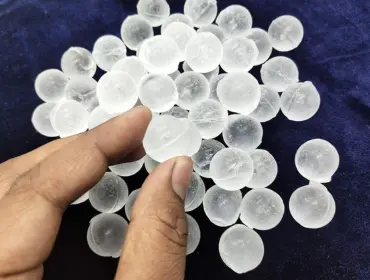
Slow-Release RO Antiscalant Balls in Bangalore (Siliphos)
Bangalore's water story is different from most Indian cities, and it shapes how scale control has to be approached here. The city draws from three distinct sources — the Cauvery river system piped in from over 100 kilometres away, BWSSB municipal supply distributed through an ageing network, and thousands of private borewells drilled into the granite bedrock of the Deccan plateau. Cauvery water is comparatively soft but picks up organic load during monsoon. BWSSB water varies in hardness depending on which reservoir it is drawn from and how long it sits in the distribution network. Borewell water in the industrial belts of Peenya, Bommasandra and Yeshwanthpur can carry hardness well above 400 ppm as CaCO₃, along with traces of iron and silica from the granite itself. Innova Corporate (India) supplies its RO Antiscalant Balls in Bangalore specifically for this spectrum — one product that works across all three water types without reformulation.
The chemistry behind these balls is simple in concept but effective in practice. Each ball is a compressed blend of food-grade polyphosphate that dissolves slowly as water flows through the housing. As it dissolves, it releases a small but consistent concentration of polyphosphate into the water — typically around 2-3 ppm. This polyphosphate does two things at once. First, it forms a microscopic protective film on metallic surfaces — pipes, coils, tanks — that shields them from oxidative corrosion. Second, it interferes with the crystallization of calcium and magnesium carbonate by keeping the mineral ions in a soluble, non-adherent form. The result is that scale does not deposit on surfaces or on downstream RO membranes, and existing light scale can gradually dissolve back into solution.
For Bangalore plants, the practical comparison is usually against traditional ion-exchange softeners. Softeners remove hardness by exchanging calcium and magnesium ions for sodium on a resin bed. They work well, but they come with a set of ongoing costs: regular salt replenishment, periodic resin cleaning or replacement, and a regeneration cycle that dumps concentrated brine into the drain. In cities like Bangalore where water and discharge are increasingly regulated, this brine waste is a compliance concern. Siliphos antiscalant balls avoid all of this. There is no salt, no resin, no regeneration, and no brine discharge. The balls simply need to be replaced every few months when they dissolve. For small and mid-sized plants in Peenya, Bommasandra and Yeshwanthpur that cannot justify the space, capex and maintenance of a full softener system, this is a practical alternative that delivers most of the benefit at a fraction of the complexity.
Why Bangalore Facilities Choose These Antiscalant Balls:
- Three-Source Compatibility: Works reliably on Cauvery river water, BWSSB municipal supply and granite-bedrock borewell water — no reformulation when sources change.
- Dual Corrosion & Scale Control: Polyphosphate film protects pipes and coils while simultaneously preventing carbonate scale deposition.
- Softener-Free Operation: No salt storage, no resin replacement, no brine discharge — reduces both operational cost and compliance burden.
- Energy Savings: Even 1mm of scale on boiler or heater coils can raise energy costs by up to 15% — preventing it delivers direct savings.
- Corrosion-Safe on All Piping: Effective in galvanized steel, copper, and plastic systems common in Bangalore's mixed-age buildings.
- Existing Scale Removal: Gradually dissolves older iron oxide (brown) deposits common in ageing pipelines and storage tanks.
- Maintenance-Free: Slow dissolution means months of protection without pumps, electricity, or daily chemical handling.
Technical Specifications
| Parameter | Value / Specification |
|---|---|
| Purity | 71.0% min |
| pH Value | 3.5 – 4.0 |
| Average Weight | 10 +/- 0.5 gm per ball |
| Dissolution Rate | 0.03 – 0.05 g / 24 hours |
| Water Insoluble | 0.06 % max |
| Heavy Metals (as Pb) | 8 ppm max |
| Iron Content | 40 ppm max |
Typical Installations Across Bangalore:
- Apartment & Gated Community RO: Reliable scale protection for household RO units and community water systems across Koramangala, Indiranagar, Jayanagar and HSR Layout.
- Cafes, Restaurants & Cloud Kitchens: Simple scale control for commercial RO systems drawing directly from BWSSB supply or private borewells.
- Industrial Pre-Filter Housings: Standard 10-inch and 20-inch housings protecting RO membranes in Peenya, Bommasandra and Yeshwanthpur.
- IT Park & Tech Campus Systems: Reliable scale prevention for large commercial RO systems serving Electronic City, Whitefield and Outer Ring Road tech parks.
- Boiler & Cooling Tower Pre-treatment: Preventing scale build-up in coils and heat exchangers across Bangalore's manufacturing base.
- Older Commercial Buildings: Gradual removal of existing iron oxide scale in ageing pipelines that still serve hotels, hospitals and offices.
Storage & Handling: Store in a cool, dry place. These balls are designed for slow dissolution; ensure proper water flow through the housing for optimal results at your Bangalore site. For more details on shelf life and application, please refer to our Technical Data Sheet (TDS) and MSDS.