- 2B / BW Shalimar Bagh, Opp. BQ Market, Near DLF Mall New Delhi - 110088, India.
- :+91-9312-871-070

Manufacturers, Exporters, Suppliers of High pH Membrane Cleaner
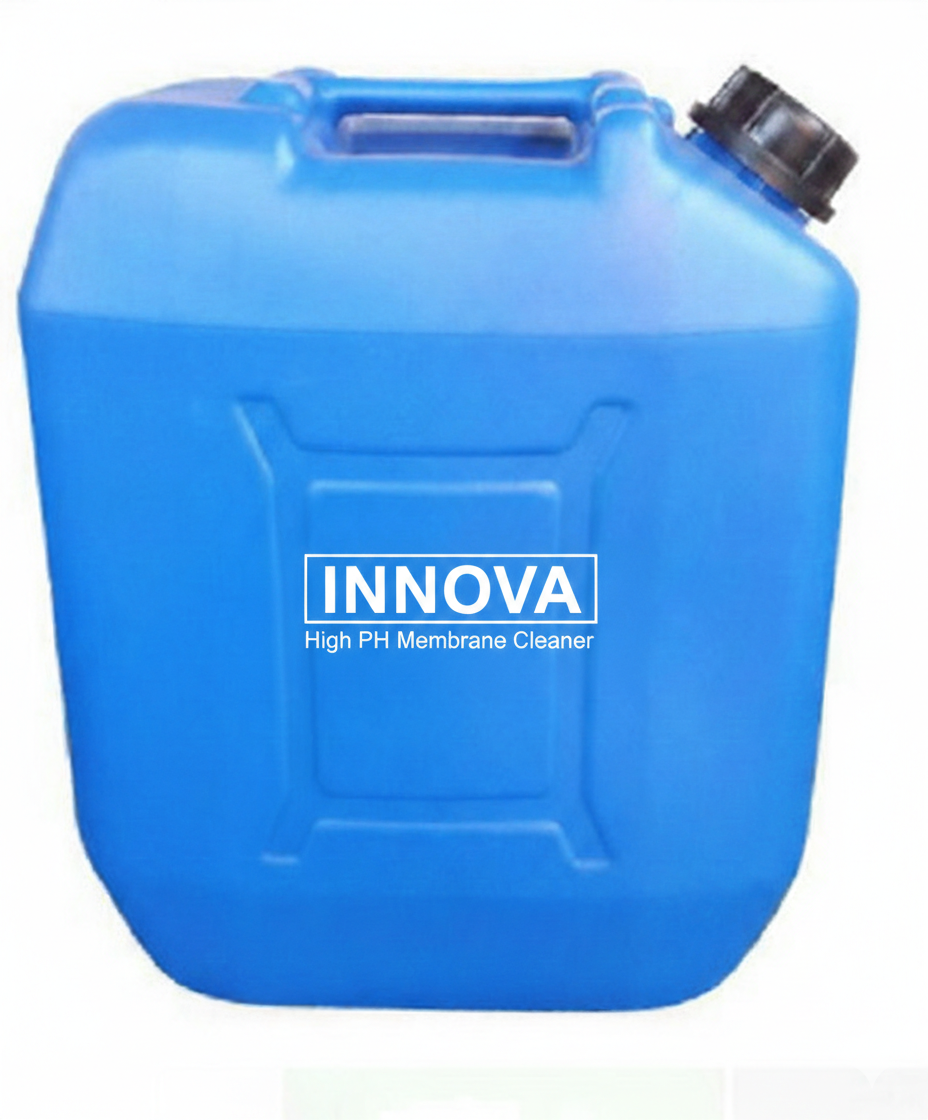
Professional High pH Membrane Cleaner for Bhutan Plants (Low-TDS Biofilm & Organic Fouling Removal, BSB & NEC Compliant)
Organic fouling and biofilm accumulation are major concerns for RO plants in Bhutan, but the sources of that fouling are specific to the country's Himalayan environment. Hydropower auxiliary cooling water at Chukha, Tala, and Punatsangchhu develops low-TDS biofilm — thin, slimy, and tenacious rather than thick and mineral-rich. Food processing operations in Thimphu and Phuentsholing accumulate organic matter from seasonal agricultural sources. Cement plants at Penden and Dungsam develop combined oil-and-biofilm fouling in cooling water systems. And municipal water utilities across Bhutan, drawing from glacial meltwater with very low mineral content, develop biofilm that standard alkaline cleaners handle poorly. Innova Corporate (India) supplies this professional high pH membrane cleaner for Bhutan plants specifically to address those fouling sources. The product is compliant with BSB (Bhutan Standards Bureau) requirements and NEC (National Environment Commission) discharge regulations.
This alkaline cleaner is essential for the periodic maintenance of water plants in Bhutan to restore flux and ensure high purity. It effectively breaks down the organic layers that cause performance drops — particularly the low-TDS biofilm that hydropower cooling systems develop, which standard cleaners formulated for high-hardness water often fail to fully penetrate. For Bhutan food processing units in Thimphu and Phuentsholing, the cleaner removes oils, proteins, and organic residue that accumulate from seasonal agricultural sources, ensuring high-quality process water consistently. For cement plants at Penden and Dungsam, it removes the machinery oil and biological slime that reduce heat transfer efficiency in cooling water systems. And for municipal utilities in Thimphu and Paro, it removes biofilm from glacial meltwater systems without introducing residual odour or taste.
For Bhutan specifically, the formula performs reliably across the country's cold Himalayan range — from 0°C in high-altitude winter conditions to 20°C in lowland summer. Alkaline cleaning chemistry is temperature-sensitive, and formulations must be optimised for Bhutan's cold range rather than for tropical conditions. Our high pH cleaner maintains full efficacy from 0°C to 40°C, so no heated CIP or seasonal adjustment is required — critical for hydropower operations at Chukha and Tala that run continuously year-round across different altitude zones.
Key Features & Strategic Benefits for Bhutan Industries:
- BSB & NEC Compliant: Formulated to meet Bhutan Standards Bureau requirements and National Environment Commission discharge regulations — documentation support available for Bhutan facility audits.
- Superior System Clean-up: High pH formulation specifically targets organic matter and silica scales found in Bhutan hydropower cooling water, food processing streams, and glacial meltwater sources.
- Low-TDS Biofilm Removal: Penetrates and removes the thin, slimy biofilm that develops in Bhutan's glacial meltwater — a biofilm type that standard alkaline cleaners handle poorly.
- Combined Oil & Biofilm Removal: Handles the mixed oil-and-biofilm fouling that develops in cement plant recirculating cooling systems at Penden and Dungsam — a challenge standard cleaners leave behind.
- Colloidal Dispersion: Penetrates deep into biological films and colloidal clay for complete removal in a single CIP cycle.
- Low Foaming Formula: Engineered for seamless use in high-velocity recirculation cleaning methods used in large Bhutan hydropower and cement RO skids.
- High Concentration: Delivers exceptional results even at low dilution ratios — highly cost-effective for Bhutan industries running continuous operations.
- Eco-Friendly & Biodegradable: Safe for the environment and complies with NEC wastewater discharge norms.
- Cold Himalayan Performance: Full efficacy from 0°C to 40°C — covering Bhutan's high-altitude winter conditions and lowland summer temperatures. No heated CIP required.
- Versatile Application: Fully compatible with a wide range of RO, Nanofiltration (NF), and Ultrafiltration (UF) membranes, plus standard housings, gaskets, and CIP skid components.
Application Guidelines for Bhutan Plants: For optimal restoration of systems in Bhutan, dilute with DM or permeate water to create a 2–5% v/v working solution. Recirculate the solution through the membrane system for 2–4 hours, allowing for a 30–60 minute soak period. Continue flushing with DM water until the pH level stabilises at both the feed and permeate ends. If the solution becomes heavily turbid or fouled during the process — common with hydropower cooling water and cement cooling applications — it should be replaced with a fresh batch. For combined organic and silt fouling, we recommend the alkaline-then-acid sequence (high pH first, then low pH) for best results.
Recommended Applications in Bhutan: Hydropower plants at Chukha, Tala, and Punatsangchhu for auxiliary cooling water biofilm; cement plants including Penden Cement and Dungsam Cement for cooling water oil and biofilm removal; ferroalloy plants including Bhutan Ferro Alloys for cooling and process water; food processing and beverage bottling in Thimphu and Phuentsholing; tourism and hospitality facilities in Paro and Thimphu; and municipal water utilities across Bhutan.
Storage & Handling: Always shake the container well before use. Store in a cool, dry place in original packaging at your Bhutan facility, away from direct sunlight, heat sources, and incompatible materials. During monsoon season (June to September), keep containers off damp floors and away from condensation. Use appropriate PPE (splash goggles, gloves, apron) during handling. Refer to our Material Safety Data Sheet (MSDS) and Technical Procedure Sheet for detailed safety protocols and step-by-step cleaning instructions — both compliant with Bhutan regulatory documentation requirements.
Export & Technical Support for Bhutan: We ship to Phuentsholing and Thimphu through the Kolkata/Haldia Port route via the India-Bhutan land border, with onward transport to Paro, Pasakha, Gelephu, Samdrup Jongkhar, and Wangdue. All shipments include complete customs documentation, MSDS, and TDS. Our technical team provides free CIP protocol guidance — including alkaline-acid sequence, dilution ratios, contact time, temperature, and post-cleaning flush — tailored to your membrane model, fouling type, and BSB/NEC regulatory requirements.