- 2B / BW Shalimar Bagh, Opp. BQ Market, Near DLF Mall New Delhi - 110088, India.
- :+91-9312-871-070

Manufacturers, Exporters, Suppliers of Silica Antiscalant High pH
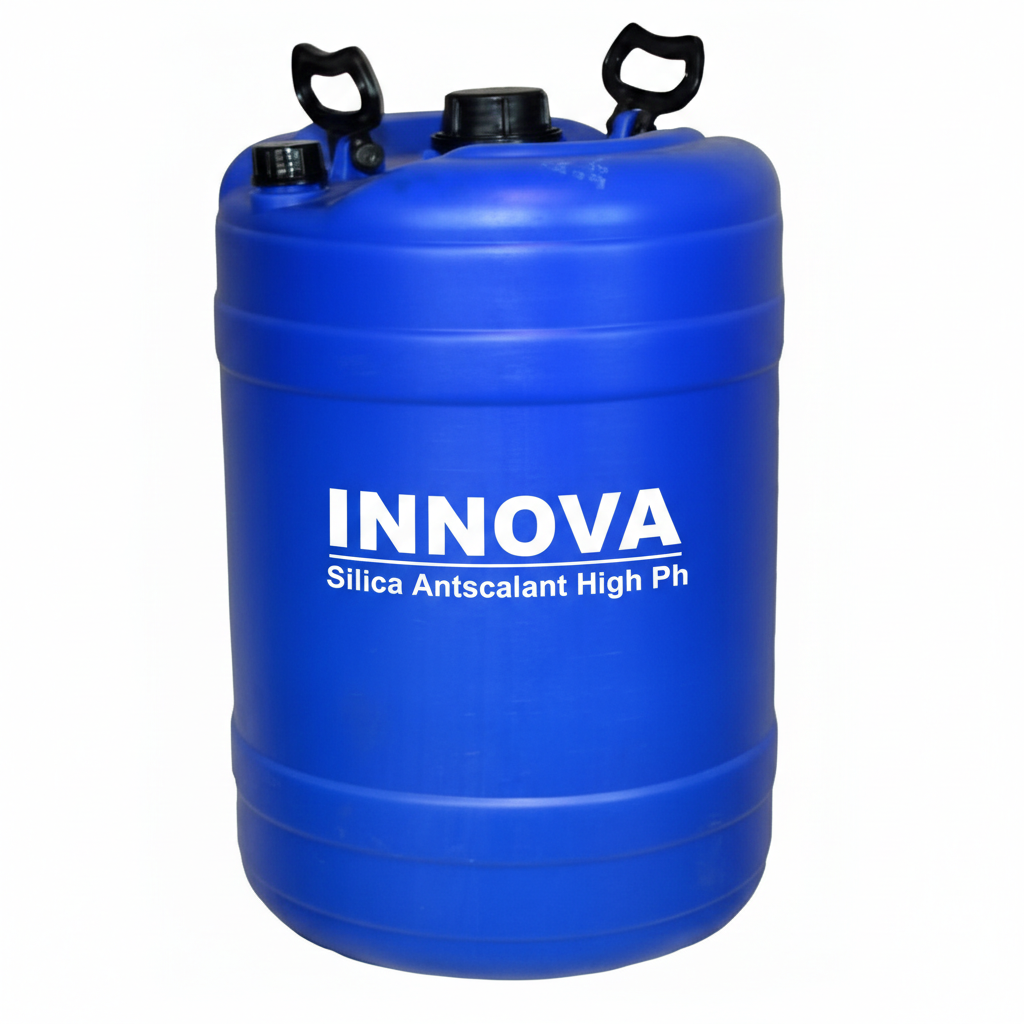
Silica Antiscalant High pH for Egypt's Fertilizer, Petrochemical & Red Sea Desalination Plants
Innova Corporate (India) is a specialized manufacturer and supplier of high pH silica antiscalants in Egypt. Silica fouling is one of the most severe challenges in RO operations because it forms a hard, glass-like scale that standard acid or caustic cleaners cannot remove once it has deposited. Our advanced alkaline formulation is specifically engineered to inhibit silica precipitation in Egypt's most demanding industrial and desalination facilities — including the fertilizer and petrochemical complexes along the Nile corridor and the Red Sea desalination plants that supply coastal industry and communities.
What makes Egypt unique is the co-occurrence of silica with phosphate and fluoride in certain industrial process waters — a combination that creates complex fouling patterns that standard silica antiscalants cannot address. Fertilizer plants processing phosphate rock generate process water streams with dissolved silica and phosphate that, when concentrated through the RO train, form amorphous calcium-silicate-phosphate deposits. Our high pH formulation is engineered to handle this multi-foulant scenario, keeping silica dissolved while simultaneously preventing phosphate and fluoride crystallization. This makes it fully compatible with drinking water systems and suitable for the full range of Egypt's desalination and industrial RO applications.
Key Benefits & Salient Features for Egypt:
- Superior Silica Control: Effectively manages high levels of silica in Egypt feed water — including the complex silica-phosphate-fluoride combinations unique to fertilizer plant process streams.
- Phosphate & Fluoride Co-Control: Prevents the co-precipitation of phosphate and fluoride with silica that leads to irreversible membrane damage in Egyptian industrial plants.
- Red Sea High-Recovery Ready: Maintains full silica inhibition at the high concentration factors typical of Red Sea desalination plants operating above 45% recovery.
- Membrane Protection: Prevents irreversible physical damage caused by sharp silica crystals that can puncture and abrade TFC and polyamide membrane surfaces once they form.
- Drinking Water Safe: Formulated with ingredients suitable for potable water applications — compliant with Egyptian drinking water quality guidelines for municipal and industrial supply.
- Cost-Efficiency: Minimizes downtime and reduces the need for expensive silica-specific cleaning cycles — a major operational saving for plants facing chronic silica load from Nile-fed or brackish sources.
- High pH Chemistry Advantage: Works best in the alkaline range where silica solubility is naturally highest — enabling higher recovery without scaling risk in Egypt's hot climate.
- Broad Membrane Compatibility: Safe with all major TFC, polyamide and cellulose acetate membranes used across Egypt's desalination and industrial RO fleet.
Why Egypt's Fertilizer Plants Need a Specialized Silica Antiscalant
Egypt is one of the largest phosphate rock producers in the world, with major fertilizer manufacturing complexes operating along the Nile corridor and near the Red Sea coast. These facilities process phosphate ore and generate substantial volumes of process water that contain dissolved silica, phosphate, fluoride and calcium. When this water is treated through RO for reuse or discharge compliance, the concentration factor drives silica beyond its solubility limit while phosphate and fluoride are simultaneously approaching their own precipitation thresholds. What forms on the membrane is not pure silica scale — it is a composite calcium-silicate-phosphate deposit that is even more resistant to standard cleaning chemistry. General-purpose silica antiscalants, designed for simple silica-only scenarios, cannot manage this complexity. Our high pH silica formulation was engineered specifically for Egypt's fertilizer plant water chemistry — it interferes with silica polymerization while simultaneously chelating calcium, dispersing phosphate and preventing fluoride crystallization. The result is a clean membrane through the full concentration range and stable permeate quality for the plant's process requirements.
High pH Silica Antiscalant Performance: Egypt Application Comparison
| Parameter | Standard Antiscalant | Innova High pH Silica Antiscalant |
|---|---|---|
| Silica Control (Feed) | Up to 50 ppm | Up to 120 ppm |
| Silica Control (Concentrate) | Up to 100 ppm | Up to 220 ppm |
| Phosphate Co-Control | Limited | Excellent — fertilizer-grade compatible |
| Fluoride Tolerance | Limited | Effective at Egypt phosphate plant levels |
| Max Recovery (Red Sea SWRO) | Up to 40% | Up to 48% |
| CIP Frequency (Fertilizer Plant) | Every 3 weeks | Every 11 weeks |
| Membrane Damage Risk | High | Minimal |
Case Study: Phosphate Fertilizer Complex Near Suez
A phosphate fertilizer complex near Suez was operating a 45 m³/hr industrial RO plant for process water reuse. Feed water from the plant's internal recycling loop carried 68 ppm silica, 12 ppm phosphate (as PO₄), 4.8 ppm fluoride and 340 ppm calcium hardness. The plant was running a general-purpose silica antiscalant at 8 ppm dosing but was experiencing rapid composite calcium-silicate-phosphate fouling on the first-stage membrane elements. CIP was required every 3 weeks, and after 14 months of operation two lead membrane elements had been replaced due to irreversible fouling that no cleaning chemistry could remove. After switching to Innova's high pH silica antiscalant at 12 ppm dosing, the facility reported CIP frequency reduced from every 3 weeks to every 11 weeks, complete elimination of the composite fouling pattern, and the ability to safely operate at 76% recovery instead of the previous 68% limit. Salt rejection on the recovered elements returned to within 0.4% of design values within 6 weeks. The plant has since standardized the formulation across two sister fertilizer facilities in the Delta region.
Application & Dosage in Egypt:
- Dosage Range: The usual dosage for silica antiscalant ranges from 2–10 ppm based on feed water silica concentration, recovery rate and operating temperature. In severe conditions or smaller installations in Egypt, this may increase up to 15 ppm. For fertilizer plant process water with combined silica, phosphate and fluoride load, dosage is typically at the upper end of this range — 10–15 ppm.
- Dosing Point: Inject continuously into the RO feed line after pretreatment and before the cartridge filter. Use a metering pump calibrated to your system flow rate.
- Storage: Store in original, tightly sealed containers in a cool, dry place in Egypt away from heat, flame and direct sunlight. Do not allow the product to freeze.
- Technical Support: Please refer to the Technical Data Sheet (TDS), product label and MSDS for comprehensive details on safety and shelf life. Free water analysis review is available for all Egypt clients.
Frequently Asked Questions — Silica Antiscalant High pH in Egypt
Q1: Why do Egypt's fertilizer plants need a specialized silica antiscalant?
Because their process water contains dissolved silica alongside phosphate, fluoride and calcium —
a combination that forms composite calcium-silicate-phosphate deposits on membranes. Standard
silica antiscalants handle only pure silica and fail in this multi-foulant environment. Our high
pH formulation is engineered to handle the complex Egypt fertilizer plant water chemistry with
a single product.
Q2: Can this antiscalant handle Red Sea seawater desalination at high recovery?
Yes. The formulation maintains full silica inhibition at the elevated concentration factors typical
of Red Sea SWRO plants operating at 45–48% recovery. It also handles the naturally occurring silica
in Red Sea seawater that concentrates through the RO train. Our Red Sea clients report stable
normalized permeate flow across the full recovery range.
Q3: What silica levels can this antiscalant handle in Egypt's water sources?
The formulation is effective at feed-side silica levels up to 120 ppm and concentrate-side
concentrations up to 220 ppm, depending on pH and temperature. This covers the majority of Egypt's
Nile-fed, Red Sea, Mediterranean and inland brackish sources. For very high silica sources,
dosage may be adjusted — our technical team provides site-specific recommendations.
Q4: Do you supply silica antiscalant across Egypt?
Yes. We supply across Egypt through Alexandria Port, Damietta Port and Port Said, with delivery to
Cairo, Alexandria, Giza, the Suez Canal Economic Zone, Sadat City, 10th of Ramadan, Borg El Arab,
Ain Sokhna and Hurghada. Standard packaging of 25 kg, 250 kg and bulk drums is available with
regular dispatch from India.