- 2B / BW Shalimar Bagh, Opp. BQ Market, Near DLF Mall New Delhi - 110088, India.
- :+91-9312-871-070

Manufacturers, Exporters, Suppliers of Antiscalant For Sea Water Desalination
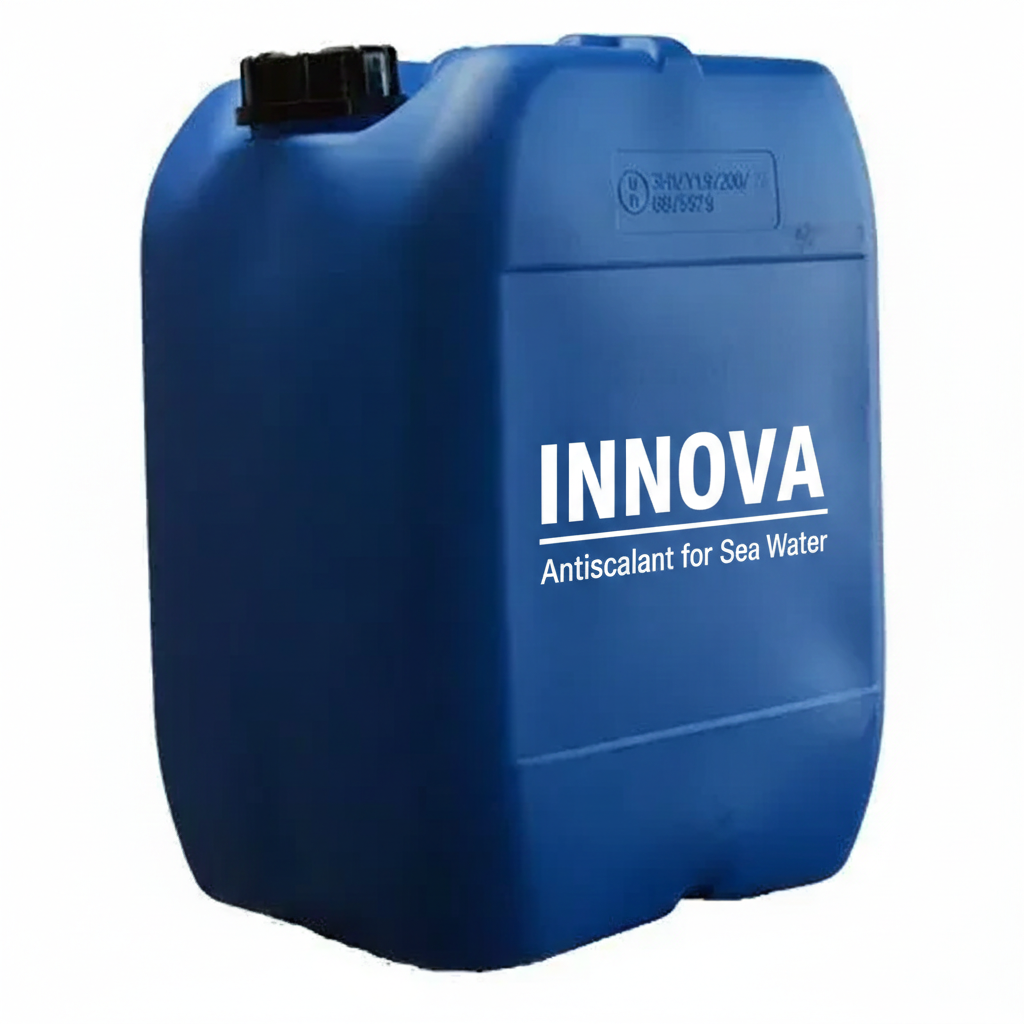
Seawater Desalination Antiscalant for Philippines (High-Salinity SWRO Scale Control)
The Philippines is an archipelago of over 7,600 islands, and for many of them — resort islands like Boracay and Palawan, industrial zones in Cebu and Batangas, and remote coastal communities across Visayas and Mindanao — seawater desalination is not a choice, it is the only freshwater source. But Philippines seawater is one of the toughest feed streams an RO plant can face. South China Sea water near Batangas and Subic, Sulu Sea water near Palawan, and Celebes Sea water near Davao all carry TDS between 33,000 and 36,000 ppm, with hardness, sulfate, and carbonate levels high enough to scale SWRO membranes within weeks if untreated. Innova Corporate (India) supplies this seawater desalination antiscalant for Philippines plants specifically to handle that chemistry at SWRO operating pressures.
The formula works at the 55 to 70 bar pressures SWRO membranes run under — where standard brackish-water antiscalants lose effectiveness. It keeps calcium carbonate, calcium sulfate, barium sulfate, strontium sulfate, and magnesium hydroxide in solution through the entire membrane train, and disperses colloidal matter and iron oxide that would otherwise co-deposit with scale and accelerate fouling. The result: stable permeate flow, lower pressure drop, and fewer acid cleanings — critical for resort islands where downtime during peak tourist season is not an option.
For Philippines SWRO operators, the biggest cost lever is energy. The Philippines has some of the highest electricity rates in Southeast Asia, and scale on SWRO membranes forces higher pump pressure to maintain output — directly increasing kWh per cubic meter. Plants using the correct antiscalant dosage typically see 8–15% lower specific energy consumption compared to those running without adequate scale control. For a resort or industrial plant running 24/7, that is a meaningful operating cost reduction.
Key Features for Philippines Coastal Operations:
- High-Salinity Performance: Maintains effective scale inhibition at TDS above 35,000 ppm — critical for South China Sea, Sulu Sea, and Celebes Sea feed water around Batangas, Cebu, Davao, and Palawan.
- Broad Spectrum Scale Control: Manages calcium carbonate, calcium sulfate, barium sulfate, strontium sulfate, magnesium hydroxide, and silica in a single dosing line.
- Colloidal & Metal Oxide Dispersion: Prevents co-deposition of colloidal clay and iron oxide that accelerate SWRO fouling, particularly near industrial coastal zones and older port infrastructure.
- Energy Cost Reduction: Keeps membranes scale-free, lowering pump pressure demand and cutting kWh per cubic meter by 8–15% in typical Philippines SWRO plants — where electricity is among the highest in Southeast Asia.
- Extended CIP Intervals: Reduces acid cleaning frequency from monthly to quarterly in most coastal installations — critical for resort islands that cannot afford downtime during peak season.
- Typhoon-Season Stability: Performs consistently across Philippines' June–November typhoon season (lower near-shore salinity, higher turbidity) and dry-season high-TDS conditions.
- Low Dosage Efficiency: Highly concentrated formula — recommended dosage of 2–6 ppm delivers full protection at minimal chemical cost.
- Membrane-Safe: Compatible with polyamide, TFC, and all major SWRO membrane brands used across Philippines coastal and island plants.
Technical Specifications for Philippines Projects
| Parameter | Value / Description |
|---|---|
| pH (as such) | 9.0 to 10.0 |
| Appearance | Pale Yellow Liquid |
| Water Solubility | Completely Soluble |
| Solid Content | 33% to 34% w/w |
| Specific Gravity | 1.17 to 1.23 |
| Recommended Dosage | 2 – 6 ppm |
| Chemical Composition | Functional phosphino carboxylic acid with advanced silica dispersants |
Recommended Applications in Philippines: Resort and hotel SWRO plants in Boracay, Palawan, Bohol, and Mactan; industrial coastal plants in Batangas, Subic, and Cebu; municipal seawater desalination in water-scarce coastal cities; offshore platform and marine support facility RO systems; and island community water supply across Visayas and Mindanao where freshwater is limited.
Dosing & Application: Dose continuously into the SWRO feed line after pretreatment and before the high-pressure pump, using a metering pump calibrated to your plant's flow rate. Typical dosage ranges from 2 to 6 ppm depending on feed TDS, recovery rate, and membrane configuration. For Philippines plants that see sharp changes between dry-season and typhoon-season feed conditions, we recommend periodic re-calibration based on updated seawater analysis.
Storage & Handling: Store in original sealed containers in a cool, dry area away from direct sunlight and heat at your Philippines facility. Keep containers off damp floors during typhoon season to prevent condensation-related contamination. Use appropriate PPE (splash goggles, gloves, apron) during handling. Refer to the Material Safety Data Sheet (MSDS) and Technical Data Sheet (TDS) for complete safety and application details.
Export & Technical Support for Philippines: We ship regularly to Manila Port (South Harbor and MICT) with onward transport to Cebu, Davao, Batangas, Subic, Boracay, and other coastal and island sites across the Philippines, with complete customs documentation. Our technical team provides free dosage calibration based on your seawater analysis — including Langelier Saturation Index, Stiff & Davis Index, and silica saturation calculations — tailored to your specific site conditions.