- 2B / BW Shalimar Bagh, Opp. BQ Market, Near DLF Mall New Delhi - 110088, India.
- :+91-9312-871-070

Manufacturers, Exporters, Suppliers of RO Antiscalant Low pH
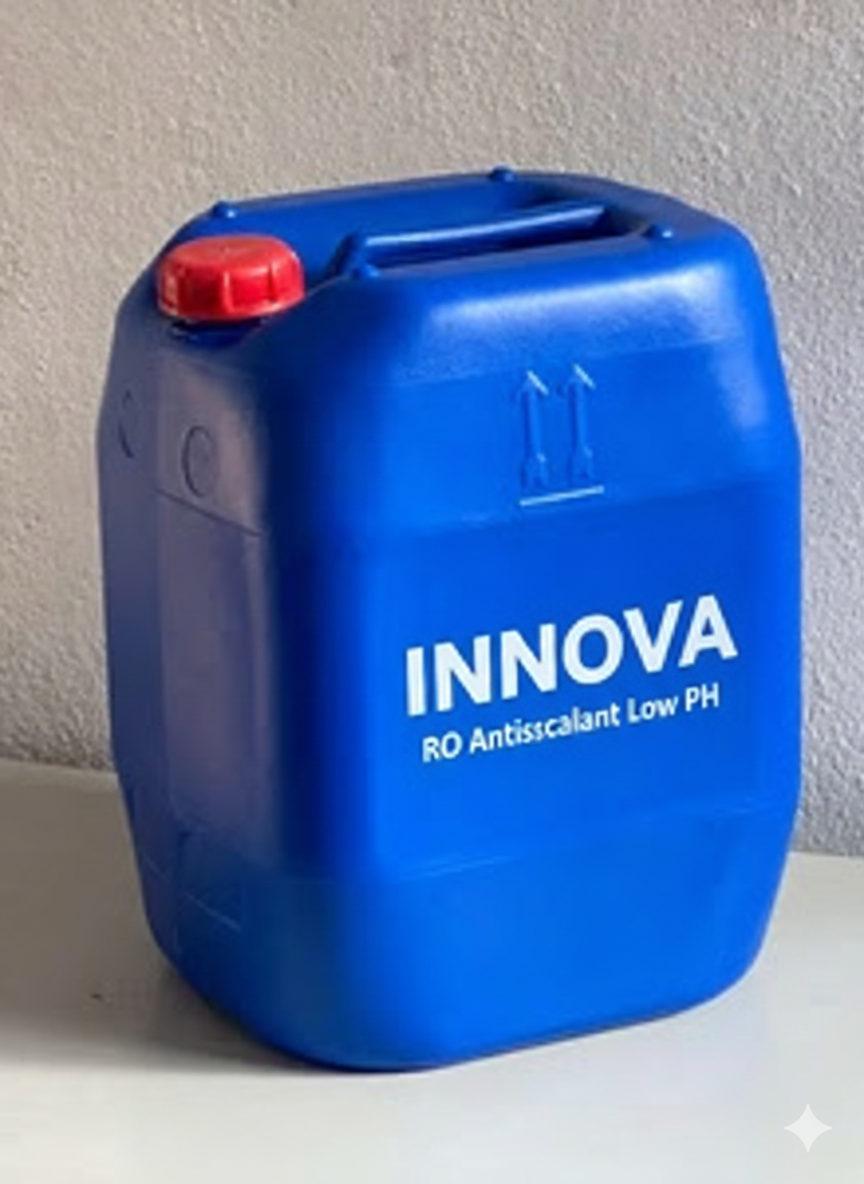
Low pH RO Antiscalant for Philippines Plants (Broad Spectrum Acidic Scale & Metal Oxide Control)
Philippines' industrial RO plants draw from a wider mix of water sources than most Southeast Asian markets — brackish groundwater in Metro Manila and Cebu, volcanic-soil aquifers in Laguna and Batangas, old cast-iron pipework in Manila's industrial estates, and semiconductor-effluent-affected sources in Cavite. Each of these brings a different scaling and metal oxide profile, and no single alkaline antiscalant handles all of them. Innova Corporate (India) supplies this broad spectrum Low pH RO antiscalant for Philippines plants specifically for that diversity — an acidic formulation that controls sulfate, carbonate, and metal oxide fouling in one dosing line.
The formula is particularly effective in high-salinity and high-TDS feed water — common in Manila's brackish aquifers and Cebu's coastal industrial wells where TDS regularly exceeds 5,000 ppm. It maintains stable performance across a pH range of 6.0 to 10.0, so plants don't need to re-tune dosing every time the source changes or the season shifts between dry and typhoon months.
It also handles the combined fouling pattern that Philippines plants deal with most — iron oxide co-deposited with calcium sulfate and silica. This mixed layer resists standard alkaline CIP and grows fast in warm feed water. This antiscalant disperses the metal oxide component in the feed stream before it can co-precipitate, keeping membrane surfaces clean for longer intervals between cleaning cycles.
Key Benefits & Performance Features for Philippines:
- Diverse Scale Inhibition: Proven effective against Calcium Sulfate, Calcium Carbonate, Barium Sulfate, Strontium Sulfate, and mixed metal oxides found across Philippines brackish, volcanic, and industrial-estate water sources.
- Metal Oxide Dissolution: Actively targets iron and manganese oxide fouling from Cavite and Laguna semiconductor-effluent sources and old Manila pipework — scale types that alkaline antiscalants leave untouched.
- High-Salinity Performance: Maintains effectiveness at TDS above 5,000 ppm — suitable for Metro Manila brackish aquifers, Cebu coastal wells, and inland plants drawing from mineral-rich sources.
- Wide pH Stability: Performs across an operating pH range of 6.0 to 10.0 — critical for Philippines plants whose feed chemistry shifts between dry season and typhoon-season runoff.
- Low Dosage Efficiency: Recommended dosage of only 1–6 ppm delivers full protection — reducing total chemical spend for large Philippines factories running continuous RO lines.
- Instant Solubility: Dissolves fully and uniformly in water with simple mixing — no heated tanks or specialised dosing equipment required.
- Membrane-Safe Acidic Cleaning: Buffered formula protects polyamide, cellulose acetate, and thin-film composite (TFC) membranes during acid CIP, even with repeated cleaning cycles.
- Two-Step CIP Compatibility: Designed to work as the acidic stage after a high pH membrane cleaner in the alkaline-then-acid protocol used across Philippines industrial plants.
Technical Specifications:
| Appearance | Clear Liquid |
| pH (as is) | Less than 4.0 |
| Specific Gravity | 1.1 – 1.2 |
| Recommended Dosage | 1 – 6 ppm |
| Operating pH Range | 6.0 – 10.0 |
| Solubility | Easily soluble in water |
Recommended Applications in Philippines: Semiconductor and electronics plants in Cavite and Laguna with iron-affected feed water; electroplating and metal finishing units in Metro Manila; food and beverage plants in Laguna and Batangas drawing from volcanic-soil groundwater; Manila and Cebu industrial estates with old iron pipework; brackish water RO systems across coastal Philippines; and any Philippines plant running above 70% recovery where iron and hardness are the limiting factors.
Dosage & Application: Dose continuously into the RO feed line using a metering pump, or use as the acidic stage of a two-step CIP program. Typical dosage ranges from 1 to 6 ppm depending on feed water hardness, TDS, iron level, and recovery rate. For Philippines plants switching between dry season and typhoon-season feed conditions, we recommend periodic re-calibration based on updated water analysis.
Storage & Safety: Keep the product in its original sealed container in a cool, dry area at your Philippines facility, away from direct sunlight and heat. Use appropriate PPE (splash goggles, gloves, apron) during handling. During typhoon season, keep containers off damp floors and away from condensation to prevent contamination. For comprehensive safety data and application support for Philippines water treatment projects, refer to the Technical Data Sheet (TDS) and Material Safety Data Sheet (MSDS), or contact our technical helpdesk directly.
Export & Technical Support for Philippines: We ship regularly to Manila, Cebu, Davao, Cavite, Laguna, and other industrial cities across the Philippines with full customs documentation. Our technical team provides free dosage calibration based on your feed water analysis — including Langelier Saturation Index, iron concentration, and saturation calculations — tailored to your specific site conditions and industry.