- 2B / BW Shalimar Bagh, Opp. BQ Market, Near DLF Mall New Delhi - 110088, India.
- :+91-9312-871-070

Manufacturers, Exporters, Suppliers of High Silica RO Antiscalant
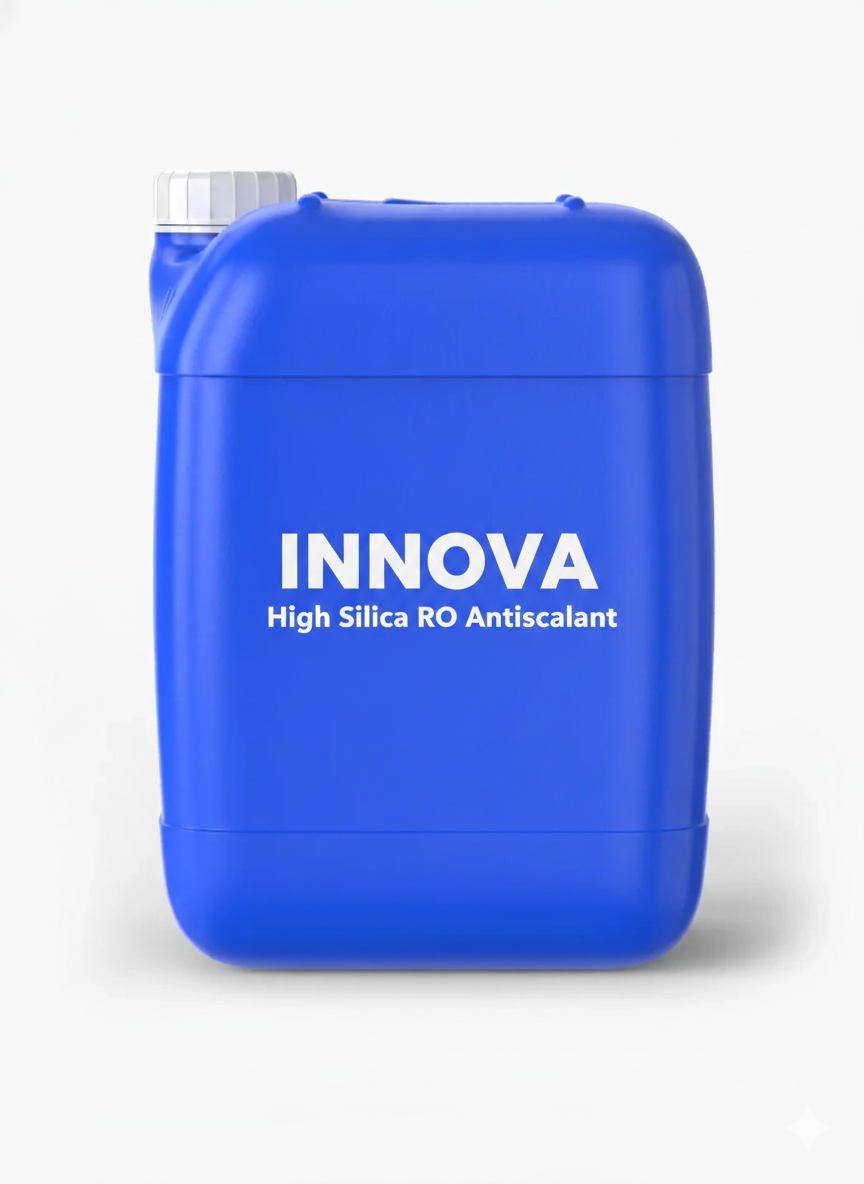
High Silica RO Antiscalant for Oman's Extreme SiO₂ Feed Water (SWRO & Brackish Plants)
Silica is one of the most unforgiving foulants in reverse osmosis — once it polymerizes on a membrane surface, it forms a glass-like deposit that standard acid and caustic CIP cycles cannot remove. Innova Corporate (India) engineers a dedicated high silica RO antiscalant in Oman for plants dealing with the elevated SiO₂ levels common in the Sultanate's inland aquifers and coastal brackish sources. From the Interior's mineral-rich groundwater feeding plants near Nizwa and Ibri to the brackish wells supplying industrial units in Al Batinah and Sohar, our formulation keeps silica soluble through the entire RO train — even at high concentration factors.
Oman's industrial expansion under Oman Vision 2040 has pushed many facilities to run RO systems at higher recoveries to reduce brine discharge and fresh water intake. But high recovery means higher silica concentration in the reject stream, and that's where standard antiscalants fail. Our high silica formulation allows plants in Sohar Free Zone, Duqm SEZ, and Salalah Free Zone to operate at recovery rates that would otherwise cause irreversible membrane damage — keeping permeate output stable through peak summer demand and Khareef-season fluctuations.
Key Features & Strategic Benefits for Oman Operations:
- Extreme Silica Inhibition: Controls silica scaling up to 325 ppm in the concentrate stream — covering the most challenging Omani groundwater conditions.
- Iron Co-Control: Advanced formula also sequesters dissolved iron (Fe²⁺ and Fe³⁺), a common companion problem in Interior and Al Batinah aquifers.
- Higher Recovery Enabled: Allows Omani plants to run at elevated recovery rates without risking silica polymerization on membranes.
- Wide Operating Window: Effective across a broad pH, TDS, and SDI range — suitable for Gulf seawater, brackish inland water, and produced water applications.
- Low Dosage Economics: Typical dosing of 2–20 ppm delivers significant chemical cost savings compared to aggressive cleaning programs.
- Universal Membrane Compatibility: Safe with all major TFC, polyamide, and cellulose acetate membranes used in Oman's desalination and industrial plants.
- Environmentally Responsible: Fully organic and biodegradable formulation aligned with Oman's environmental regulations and Vision 2040 sustainability goals.
- CIP Frequency Reduction: Prevents silica polymerization from occurring, drastically reducing cleaning cycles and extending membrane service life across Omani facilities.
Why Silica is Different from Other Scales — And Why Oman Needs a Dedicated Antiscalant
Unlike calcium carbonate or sulphate scales that can be dissolved with acid cleaning, silica scale is essentially glass. Once SiO₂ polymerizes on a membrane surface, no standard CIP chemical can remove it. The deposit must be physically scraped or the element replaced. In Oman's inland aquifers — where silica levels of 40–80 ppm are common — and in coastal brackish sources near Sohar and Duqm, this risk is real and recurring. Our high silica antiscalant works by interfering with the polymerization reaction itself, keeping silica in its dissolved monosilicic acid form so it passes through the concentrate stream instead of depositing on the membrane. This is chemistry specifically designed for Omani water conditions.
Standard Antiscalant vs Innova High Silica Antiscalant: Oman Comparison
| Parameter | Standard Antiscalant | Innova High Silica Antiscalant |
|---|---|---|
| Silica Control (Concentrate) | Up to 100 ppm | Up to 325 ppm |
| Silica Polymerization Prevention | Limited | Full inhibition |
| Iron Co-Control | Up to 1 ppm | Up to 5 ppm |
| pH Operating Range | 6 – 8 | 5 – 10 |
| Recovery Enabler (Brackish Oman) | Up to 65% | Up to 80% |
| CIP Frequency (High Silica Feed) | Every 2–3 weeks | Every 10–14 weeks |
Case Study: Interior Brackish RO Plant Near Nizwa
A brackish water RO facility in the Interior region near Nizwa was processing groundwater with 72 ppm silica, 340 ppm calcium hardness, and 1.2 ppm dissolved iron. The plant was running at 55% recovery because attempts to push higher had caused rapid silica scaling that standard CIP chemicals could not remove — one membrane set had to be replaced after only 14 months. After switching to Innova's high silica antiscalant at 6 ppm dosing, the facility safely increased recovery to 72%, extended membrane life past 3 years, and reduced CIP frequency from every 3 weeks to every 11 weeks. The plant now reports annual savings exceeding 50% in membrane replacement and cleaning costs.
Application & Dosage: For Oman plants, dose the product directly into the RO feed water tank or line after pretreatment — typically downstream of the cartridge filter and upstream of the high-pressure pump. Standard dosing ranges from 2 ppm to 20 ppm, depending on silica concentration, calcium hardness, alkalinity, pH, and target recovery. For feed water with high iron (0.5–1.0 ppm) combined with elevated silica — common in Interior and Al Batinah aquifers — a dosage of 5–7 ppm ensures full stabilization. Our technical team provides free dosing recommendations tailored to your specific Oman feed water analysis.
Frequently Asked Questions — High Silica Antiscalant in Oman
Q1: Why can't standard antiscalants control silica in Oman's water?
Standard antiscalants are designed primarily for calcium carbonate and sulphate scales. Silica follows a
different chemistry — it polymerizes rather than crystallizes. Controlling it requires a formulation
that specifically interferes with the polymerization reaction. Using a general-purpose antiscalant on
high-silica Omani feed water leads to slow but steady silica buildup that eventually becomes
irreversible.
Q2: What silica level can your antiscalant handle in Omani feed water?
Our formulation controls silica up to 325 ppm in the concentrate stream. In practical terms, this means
Omani brackish RO plants with 60–90 ppm feed silica can safely operate at 70–80% recovery. For SWRO
applications near Duqm and Salalah, the concentrate-side control is equally important and our
formulation handles it comfortably.
Q3: Can this antiscalant also handle iron and manganese in the same feed?
Yes. Interior and Al Batinah aquifers often contain silica along with dissolved iron and manganese. Our
formulation provides dual-action control — silica polymerization inhibition plus metal sequestration —
so a single product handles both fouling risks without needing a second chemical injection point.
Q4: Do you supply high silica antiscalant across Oman's industrial zones?
Yes. We supply to facilities across Oman including Nizwa, Ibri, Sohar, Duqm, Muscat, Salalah, Sur,
and Barka. Packaging options include 25 kg, 250 kg, and 1000 kg IBC, with regular dispatch from India
to Omani ports. Bulk pricing is available for large industrial consumers and multi-site operators.
Storage & Stability: Store in original, tightly sealed containers in a cool, dry environment away from direct sunlight, heat sources, and open flames at your Oman facility. Do not allow the product to freeze. For detailed handling protocols, shelf life, and safety information, please refer to our Technical Data Sheet (TDS) and Material Safety Data Sheet (MSDS).