- 2B / BW Shalimar Bagh, Opp. BQ Market, Near DLF Mall New Delhi - 110088, India.
- :+91-9312-871-070

Manufacturers, Exporters, Suppliers of RO Antifoulant
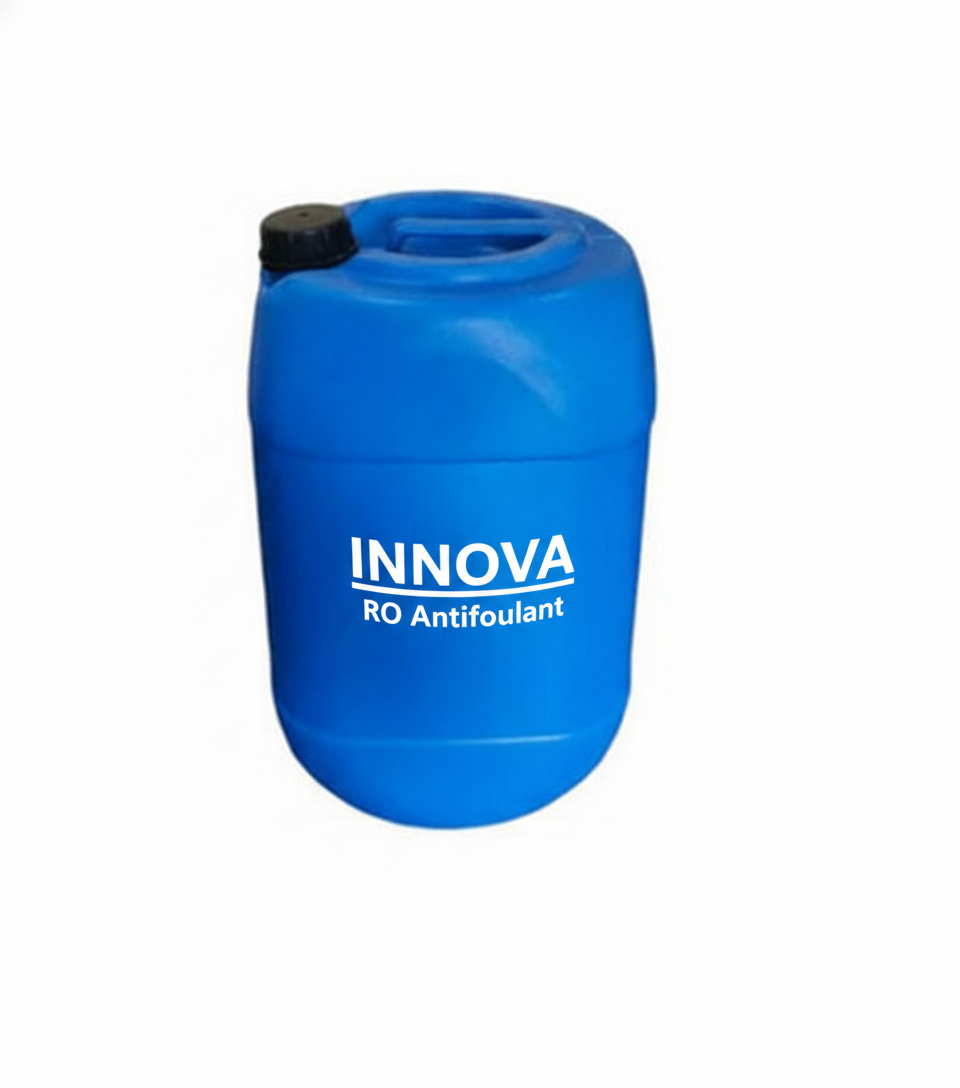
Super-Threshold RO Antifoulant & Antiscalant for Oman's Complex Feed Water
Innova Corporate (India) — an ISO 9001 certified manufacturer — supplies a dual-action RO antifoulant and antiscalant in Oman engineered for facilities that cannot afford to choose between scale control and organic fouling control. Oman's feed water rarely presents a single challenge: coastal SWRO plants near Sohar, Duqm and Salalah face mineral scaling plus seasonal algal organic loading, while inland brackish plants in Al Batinah and Interior regions combine high hardness with dissolved iron and silica. This single formulation handles all of it — eliminating the need to stock, dose and monitor multiple chemicals at different injection points.
At the core is a super-threshold stabilization mechanism that keeps supersaturated salt solutions dissolved well beyond their normal precipitation limits. This means Omani plants can push recovery rates higher — a critical economic factor for inland brackish RO systems where brine disposal is expensive, and for SWRO facilities in Duqm and Sohar where every percentage point of recovery translates directly to operational savings. The formulation also eliminates the need for hazardous acid dosing, making operation safer for plant staff working in Oman's demanding summer conditions.
The formulation is engineered to perform under the toughest conditions found across the Sultanate: feed water with an LSI (Langelier Saturation Index) up to +2.5, iron levels up to 1.2 ppm in the reject stream, and high SDI (Silt Density Index) from organic and colloidal loading. It provides robust protection against the full range of foulants in Oman's surface, ground and seawater sources — from carbonate and sulphate scales to metallic oxides and biological organic matter.
Targeted Fouling Protection for Oman Operations:
- Sulphate & Carbonate Scale Control: Inhibits calcium carbonate, calcium sulphate, barium sulphate, strontium sulphate and magnesium sulphate — the dominant scales in Gulf seawater and Interior brackish water.
- Metallic & Silica Scale Prevention: Controls calcium fluoride, iron oxide and silica deposition — problems especially common in Al Batinah aquifers and Interior groundwater.
- Organic & Colloidal Fouling Control: Disperses natural organic matter, algae byproducts and colloidal particles that cause bio-slime and pressure differential buildup in coastal SWRO plants.
- High Recovery Enabled: Maintains membrane flux and reduces specific energy consumption by keeping surfaces clean — critical for SWRO economics in Duqm and Sohar.
- Low Dosage Economics: Highly concentrated super-threshold formula requires minimal dosing, keeping chemical costs predictable even at high flow rates.
- Wide pH Stability: Performs reliably across the pH range and temperature variations typical of Omani industrial and municipal RO systems.
- Universal Membrane Compatibility: Safe for all major polyamide, TFC, and cellulose acetate RO membranes used across Oman's desalination and industrial sectors.
- Khareef Season Resilience: Maintains stable performance during Dhofar's monsoon when organic and colloidal loading in Salalah feed water spikes sharply.
Why Dual-Action Matters in Oman's Water Chemistry
Traditional RO chemical programs treat scale and organic fouling as separate problems — using an antiscalant at one injection point and an antifoulant or biocide at another. This works when feed water is predictable. In Oman, it rarely is. Coastal SWRO plants in Sohar and Salalah see seasonal algae blooms that spike organic loading for weeks; inland brackish plants in Al Batinah and the Interior encounter varying hardness, silica, and iron as aquifer conditions change; produced water from Fahud and Yibal introduces hydrocarbon and biological load that never appears in municipal sources. Our super-threshold formulation handles both scale and organic fouling mechanisms simultaneously, removing the risk of a fouling problem slipping through because it was the wrong chemical type at the wrong injection point.
Single-Chemical vs Dual-Action Program: Oman Cost & Performance
| Parameter | Separate Antiscalant + Antifoulant | Innova Dual-Action Antifoulant |
|---|---|---|
| Injection Points | 2 (separate dosing) | 1 (single point) |
| Chemical Types Stocked | 2 | 1 |
| Scale Types Covered | Carbonate, sulphate | Carbonate, sulphate, fluoride, iron, silica |
| Organic Fouling Control | Yes (separate product) | Yes (integrated) |
| LSI Tolerance | Up to +2.0 | Up to +2.5 |
| Iron Tolerance (Reject) | Up to 0.8 ppm | Up to 1.2 ppm |
| CIP Frequency (Oman Coastal SWRO) | Every 6–8 weeks | Quarterly or longer |
Case Study: Brackish RO Plant in Barka
A 30 m³/hr brackish RO plant in the Barka region was operating a traditional two-chemical program — a standard antiscalant plus a separate antifoulant. Feed water from a local aquifer carried 1,100 ppm hardness, 65 ppm silica, 0.9 ppm iron, and periodically showed organic loading from nearby agricultural runoff. Despite the two-chemical approach, the plant required membrane cleaning every 5 weeks and had suffered irreversible silica-iron fouling on one membrane set the previous year. After switching to Innova's dual-action super-threshold formulation at 4 ppm single-point dosing, the plant reported CIP frequency extended to every 12 weeks, complete elimination of the silica-iron fouling pattern, and a 42% reduction in annual chemical + labor costs compared to the previous program. The facility now runs continuously through peak summer demand without shutdowns.
Dosage & Application: For most Omani plants, the dual-action formulation is dosed at 2 to 6 ppm into the RO feed line after pretreatment and before the cartridge filter. Plants facing extreme conditions — high LSI, elevated iron, or heavy organic loading — may require dosing up to 8 ppm. Our technical team provides free dosage recommendations based on your specific feed water analysis, recovery target, and system configuration. A single injection point is all that's required, which simplifies plant design and reduces monitoring overhead for Omani operators.
Frequently Asked Questions — RO Antifoulant in Oman
Q1: Can a single antifoulant really handle both scale and organic fouling?
Yes, when it's formulated as a super-threshold stabilizer with integrated dispersants. Unlike older
products that were purely scale inhibitors or purely organic dispersants, modern dual-action formulations
work on both fronts simultaneously. This is especially valuable in Oman, where feed water often presents
multiple fouling mechanisms at once.
Q2: What LSI level can this antifoulant handle in Omani feed water?
Our formulation is effective up to LSI +2.5, which covers the majority of brackish water conditions
found across Al Batinah and Interior regions. For SWRO applications with LSI above +2.5, additional
dosing adjustment or partial acidification may be required. Our team will advise based on your water
analysis.
Q3: Does it eliminate the need for acid dosing in Oman plants?
In most cases, yes. Because the formulation keeps supersaturated salts stable without pH adjustment,
plants can eliminate the safety and corrosion risks of sulfuric or hydrochloric acid handling. This
is a significant operational improvement for facilities in Oman's hot climate where acid handling
adds substantial safety overhead.
Q4: Do you supply this antifoulant across Oman's industrial zones?
Yes. We supply across Oman including Muscat, Barka, Sohar, Duqm, Salalah, Nizwa, Sur and all major
industrial zones. Standard packaging of 25 kg, 250 kg, and 1000 kg IBC is available with regular
dispatch from India to Omani ports. Bulk pricing is available for multi-site industrial and municipal
operators.
Storage & Support: Keep in original, tightly sealed containers in a cool, dry place away from direct sunlight and heat sources at your Oman facility. Do not allow the product to freeze. For detailed dosing charts, water analysis support, and shelf-life information, please refer to our Technical Data Sheet (TDS) and Material Safety Data Sheet (MSDS), or contact our technical team specializing in Oman water treatment solutions.